

I thought I knew Islam…until this
The missing piece

I was born Muslim and come from a family of Islamic teachers and scholars. A typical weekend growing up involved attending some sort of Islamic lecture, halaqa or convention/conference. I watched my own mom walk on countless stages and speak to thousands of people about various Islamic topics.
But despite my religious upbringing, I felt like I was missing something.
I remember at one of these Islamic conventions realizing that the majority of the speakers on the stage were reverts. It piqued my curiosity. I felt grateful for being born Muslim but I craved what they had…
There was this drive and deep desire for the deen that felt contagious when they spoke.
It was then that I understood that being born into and growing up in a religious Muslim family didn’t equate to being a spiritual Muslim.
Whether or not you are born Muslim, you still have to choose Islam.
I realized: You have to consciously choose Islam, and keep choosing it over and over again.
I started redefining my relationship with Allah and Islam in my 20s, and now, in my early 30s, I find myself digging deeper and wanting to prioritize it over everything else.
A lot of what I write about below I knew, but when the mind and heart connected, it changed everything for me. Islam was no longer a rule book. It gave me a lens to see everything differently. A lens that’s clear, grounding, gives purpose, meaning and direction.
Tawhid: Not just a belief, but a compass
Oftentimes with religion we can get caught up in saying “things are the way they are” without really trying to understand the deeper reasons behind them.
Believing in Allah’s Oneness is not just a tenet and not just about rejecting idol worship. Its meaning transforms when you realize it’s about more than that.
It’s about what sits at the center of your life.
It’s knowing that nothing and no one is more important than Him and your relationship with Him. It guides your decisions, actions and the direction you’re heading in. It’s your compass in this world to help get you to the akhirah you desire.
It also has different implications today beyond worshiping idols — are we placing more importance on money and prioritizing making money over our worship of Allah? Are we valuing this world over our connection with Him? Are we wasting our time knowing and talking about the lives of others over the time we could be spending getting closer to and praising Allah? Do we care about what others think more than pleasing or displeasing Him?
The hard truth is: If something is not leading you closer to Allah, it’s probably pulling you further away from Him.
It can be subtle, and that’s what I’ve realized. The mindless eating, the doom scrolling, the binge-watching turning into brain (and heart) rot.
Allah tells us in Surah Al-Jathiyah:
أَفَرَءَيْتَ مَنِ ٱتَّخَذَ إِلَـٰهَهُۥ هَوَىٰهُ وَأَضَلَّهُ ٱللَّهُ عَلَىٰ عِلْمٍۢ وَخَتَمَ عَلَىٰ سَمْعِهِۦ وَقَلْبِهِۦ وَجَعَلَ عَلَىٰ بَصَرِهِۦ غِشَـٰوَةًۭ فَمَن يَهْدِيهِ مِنۢ بَعْدِ ٱللَّهِ ۚ أَفَلَا تَذَكَّرُونَ
“Have you seen ˹O Prophet˺ those who have taken their own desires as their god? ˹And so˺ Allah left them to stray knowingly, sealed their hearing and hearts, and placed a cover on their sight. Who then can guide them after Allah? Will you ˹all˺ not then be mindful?” [45:23]
Tawhid serves as a reminder of Who you prioritize, turn to, rely on and ultimately allow to guide your life.
Istighfar/Tawba: Not just for big sins
For a long time, I thought istighfar and tawba (repentance) were reserved for major sins. But what I didn’t realize is that I could be sinning even when I don’t think I am. After all, it was pride and takabbur that turned Iblis from a devoted worshipper into the most cursed of creation.
Reflecting on that changed my relationship with istighfar completely. Istighfar and tawba became less of a reaction and more of a constant state and a constant returning.
Prophet Muhammad (peace and blessings be upon him), despite being forgiven, would seek forgiveness often:
“By Allah! I ask for forgiveness from Allah and turn to Him in repentance more than seventy times a day.” (Sahih al-Bukhari 6307)
Making istighfar sincerely and often can help unlock rizq and bring barakah into your life. Your sins, whether you’re mindful of them or not, could be blocking greatness in your life and of course, affect your akhirah.
Living for the akhirah
Realizing the magnitude of accountability on the Day of Judgment also deepened the importance of istighfar in my daily life. It made me more mindful of my words, my intentions and the subtle ways we can distance ourselves from Allah without even realizing it.
At the same time, it also taught me to let go of trying to control everything in this dunya. Because I know Allah’s justice is coming. Nothing goes unseen. Nothing goes unaccounted for.
What once felt urgent in the dunya starts to feel temporary when you begin living with the akhirah in mind.

You start thinking differently about your actions, your priorities, your intentions and even your time. You stop obsessing over and getting overwhelmed by things, situations and people when you remember that this life is temporary and eventually all that’s in it will fade. When you truly internalize that, it changes how you move through this life.
Allah reminds us in Surah Al-A’la:
بَلْ تُؤْثِرُونَ ٱلْحَيَوٰةَ ٱلدُّنْيَا
وَٱلْـَٔاخِرَةُ خَيْرٌۭ وَأَبْقَىٰٓ
“But you ˹deniers only˺ prefer the life of this world,
even though the Hereafter is far better and more lasting.” [87:16–17]
Quran: More than a Holy Book
Growing up, I viewed the Quran as a sacred book, one that required a certain level of knowledge to truly understand or deeply engage with it. I respected it, loved it and recognized its holiness, but I still felt distant from it in some ways. It wasn’t until I started reading it in a language I fully understood that everything changed.
I’ve been reading the Quran from cover to cover in translation and it’s rewired my brain chemistry, opened my heart, deepened my love, understanding and connection to it in ways I still struggle to articulate.
It’s become my safe space, my source of peace, my guide and the place I turn to when I need clarity, grounding or reassurance.
The Quran is the only book where the Author loves the reader. I now see it as a Divine love letter from Allah – first revealed to Prophet Muhammad (peace and blessings be upon him), but meant for all of us until the end of time.
When Allah comforts and reassures the Prophet (peace and blessings be upon him) and the other prophets throughout the Quran, He is also comforting and reassuring us. Their stories stopped feeling ancient and started feeling deeply human and relevant to my own life today.
That’s the miracle of the Quran. It was relevant to the people living at the time it was revealed, and it continues to speak directly to the hearts of people centuries later who read it, recite it and reflect on it.
Its guidance is timeless.
وَنُنَزِّلُ مِنَ ٱلْقُرْءَانِ مَا هُوَ شِفَآءٌۭ وَرَحْمَةٌۭ لِّلْمُؤْمِنِينَ ۙ وَلَا يَزِيدُ ٱلظَّـٰلِمِينَ إِلَّا خَسَارًۭا
“We send down the Quran as a healing and mercy for the believers, but it only increases the wrongdoers in loss.” [17:82]
There is guidance, healing and wisdom in the Quran for everything we are going through in this life. How can we not prioritize reading it and letting it guide our lives?
Sadaqah: Giving from what you love
Many of us grow up knowing that giving charity is an important pillar of Islam, but I only recently started to internalize the wisdom behind it, and even now, I know it’s probably only a small glimpse of what we’re truly meant to understand from it.
After everything Allah has blessed us with, sadaqah becomes more than simply giving money away. It becomes an act of detaching the heart from this dunya – a reminder that nothing we have truly belongs to us in the first place. Our wealth, time, possessions and blessings are all trusts and tests from Allah, and giving from what we love conditions the heart not to become consumed by or overly attached to this world.
It also shifts your perspective outward. No matter what challenge, hardship or test we are facing, there is always someone else longing for something Allah has already blessed us with. Sadaqah nurtures gratitude, softens the heart and reminds us that caring for one another is part of what it means to live as an ummah.
لَن تَنَالُوا۟ ٱلْبِرَّ حَتَّىٰ تُنفِقُوا۟ مِمَّا تُحِبُّونَ ۚ وَمَا تُنفِقُوا۟ مِن شَىْءٍۢ فَإِنَّ ٱللَّهَ بِهِۦ عَلِيمٌۭ
“You will never achieve righteousness until you donate some of what you cherish. And whatever you give is certainly well known to Allah.” [3:92]
The ease in tawakkul
We spend so much of our lives overthinking outcomes, trying to force certainty, trying to understand why things are happening the way they are. But tawakkul teaches us to do our part, tie our camel and leave the rest to Allah.
Trusting Allah takes such a weight off your shoulders because you realize you were never meant to carry it in the first place. There’s so much peace in knowing that Allah sees the full picture while we only see pixels of it.
One of the most profound stories that shifted my understanding of this was the story of Musa (peace be upon him) and Al-Khidr in Surah Al-Kahf. Musa questioned things that appeared unfair, confusing and even wrong on the surface, only to later realize there was divine wisdom behind every single situation that occurred in their journey together.
That story deeply humbled me because it reminded me that we are incapable of fully understanding Allah’s wisdom, and yet we are still called to trust Him anyway.
In Surah Al-Baqarah, Allah reminds us:
…وَعَسَىٰٓ أَن تَكْرَهُوا۟ شَيْـًۭٔا وَهُوَ خَيْرٌۭ لَّكُمْ ۖ وَعَسَىٰٓ أَن تُحِبُّوا۟ شَيْـًۭٔا وَهُوَ شَرٌّۭ لَّكُمْ ۗ وَٱللَّهُ يَعْلَمُ وَأَنتُمْ لَا تَعْلَمُونَ
“…Perhaps you dislike something which is good for you and like something which is bad for you. Allah knows and you do not know.” [2:216]
Having tawakkul doesn’t mean life will suddenly become easy, but it does train your heart to become more at ease because you understand Who is truly in control and that this is just dunya.
Hardship is a test and a mercy
One of the most transformative shifts has been understanding that hardship is also a mercy from Allah.
Trials and tribulations in this life can become a means of purification, elevation and closeness to Allah.
Prophet Muhammad (peace and blessings be upon him) said:
“No fatigue, nor disease, nor sorrow, nor sadness, nor hurt, nor distress befalls a Muslim, even if it were the prick he receives from a thorn, but that Allah expiates some of his sins for that.” (Sahih al-Bukhari 5641, 5642)
Sometimes hardship is meant to wake you up, purify you, redirect you or bring you back to Allah.
Salah: Opportunity to detach and reconnect
Another shift for me was no longer viewing salah as a chore or a “have to,” but rather as a “get to.”
Allah gave us everything – our bodies, our families, our rizq, every blessing we’ve ever known, and in return, we are asked to pause throughout the day and remember Him.
Allah says in Surah Taha:
إِنَّنِىٓ أَنَا ٱللَّهُ لَآ إِلَـٰهَ إِلَّآ أَنَا۠ فَٱعْبُدْنِى وَأَقِمِ ٱلصَّلَوٰةَ لِذِكْرِىٓ
“’It is truly I. I am Allah! There is no god ‘worthy of worship’ except Me. So worship Me ‘alone’ , and establish prayer for My remembrance.” [20:14]
At the core of it all, our entire purpose in this life is to worship Allah. Yet somehow, we can spend hours scrolling, consuming, working, worrying and pouring ourselves into this dunya, while struggling to give Allah even a small portion of our time.
In 24 hours, we are prescribed to pray five times a day. If you spend five minutes on each prayer, that’s only 25 minutes a day. Just 25 minutes spent doing what we were ultimately created to do for the One who created time.
When you think about it that way, salah begins to feel less like an obligation and more of a way to express our gratitude and love for Allah.
Salah becomes an opportunity to detach from the dunya multiple times a day — a chance to step away from the noise, the stress, the distractions and return to Allah. It’s one of the most powerful forms of spiritual, emotional and nervous system regulation we’ve been given.
I recently read a note about how Ibn al-Qayyim said one of the signs of a sound heart is finding it difficult to leave the prayer once you enter it.
Shifting your perspective will help deepen your relationship with prayer. You’ll begin to crave staying in sujood longer. Sitting with Allah longer. Lingering in that closeness a little more before returning back to the dunya.
—
There’s a hadith where Prophet Muhammad (peace and blessings be upon him) said that Allah says:
“I am as My servant thinks I am…” (Hadith 15, 40 Hadith Qudsi)
If you truly believe that Allah is All-Forgiving, Most Merciful and always near, you begin to see traces of that in your life.
Your perception of Allah shapes your relationship with Him.
A lot of us know Islam intellectually. We grow up hearing the verses, the stories, the rulings and the reminders. But when that knowledge moves from the mind to the heart, everything begins to shift.
And maybe this mind-heart connection is the missing piece many of us don’t realize we’re longing for.
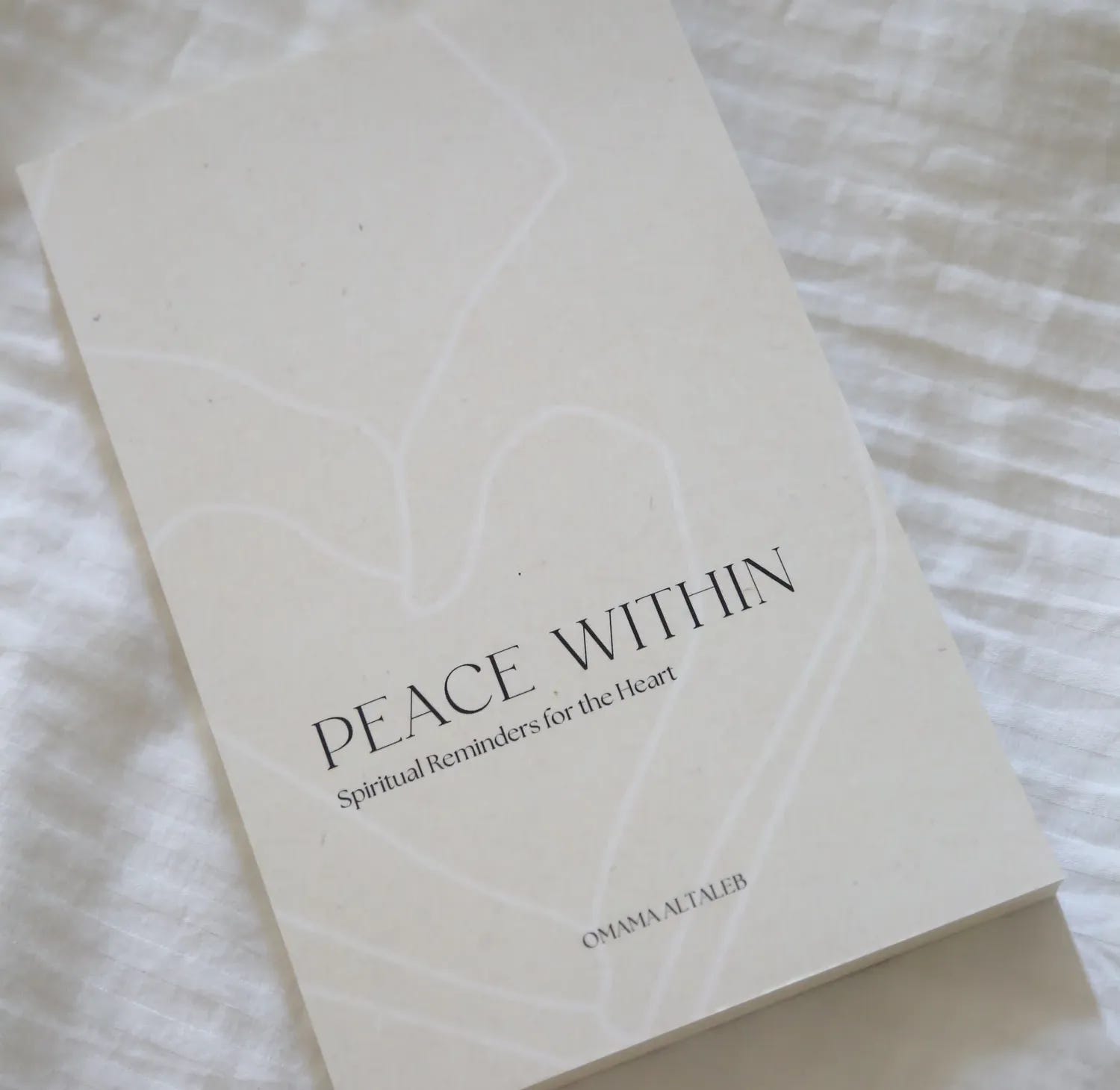
If this resonated with you, my book Peace Within: Spiritual Reminders for the Heart continues these themes in a slower, more intentional way. It’s a collection of short, Islamic reminders to help you reconnect with Allah, tend to your heart, and return to what truly matters.